

Continuously serving Kosciusko County since 1854
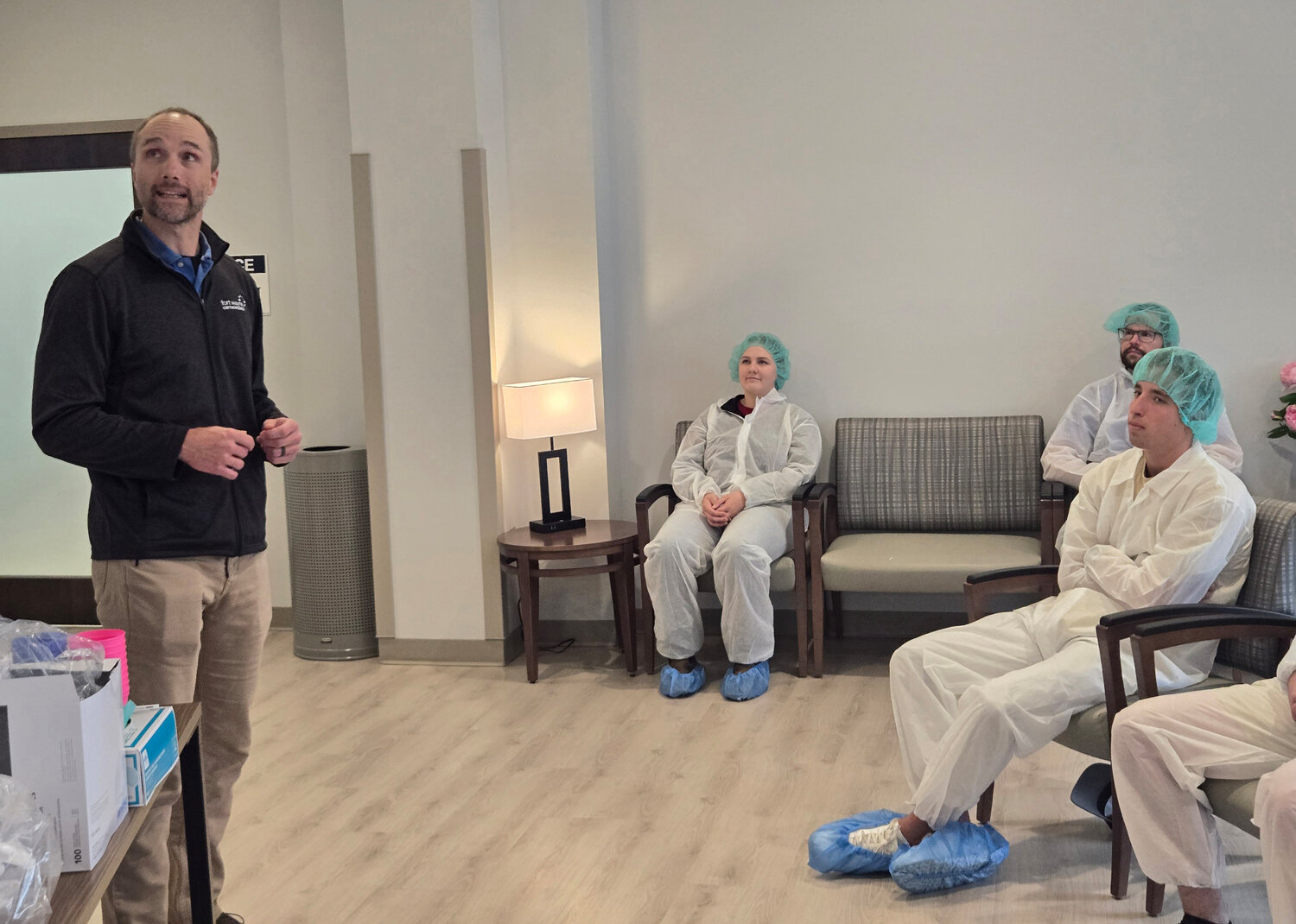


The Orthopedic Hospital Warsaw Surgical Center hosted participants of the Orthopedic Institute's first MBA program as part of the Orthopedic Scholar Institute Seminar Series.
Dr. Allyn Decker, vice president of operations and engagement at OrthoWorx, said the orthopedic MBA program was a partnership between some industry representatives and Grace College as a way to attract talent to the area, develop talent and hopefully plug people into permanent roles once they finish the program.
The seminar series is part of the program and is a way to introduce students and young professionals in the area to the orthopedic industry and subject-matter experts from the industry. Each of the five seminars is presented by local orthopedic professionals.
The seminar series is sponsored by Grace College and OrthoWorx.
With putting on the seminar series, Decker said they’re hoping to help students and young professionals understand some of the finer points of the orthopedic industry.
One seminar held on May 23 was about how Warsaw became the Orthopedic capital of the world. Friday’s seminar was held at The Orthopedic Hospital Warsaw Surgical Center to talk about robotic surgery and the surgeon/sales representative relationship.
On June 13, there will be a seminar focusing on product and business portfolio management featuring Jim Lancaster, senior vice president and executive director, head of global product development, at Zimmer Biomet.
On June 27, there will be a seminar about contract manufacturing.
Orthopedic surgeon Dr. David Feaker spoke to participants of the program Friday before they went on a tour of The Orthopedic Hospital Warsaw Surgical Center.
Feaker said he initially didn’t intend to go to medical school. When he did go medical school, he was thinking he was going to be a family medicine doctor.
Feaker said in orthopedics, doctors are really fixing a problem, whether a joint is broken down or something else.
“That’s a sort of a unique aspect of orthopedics, is that you can really change somebody’s life for the better,” he said, noting that was the main reason that drew him to orthopedics.
Feaker spent four years with the Navy after graduating medical school, where he “did all kinds of sports stuff,” like fixing tendons and reconstructing ligaments. In the general population, orthopedics is more about chronic problems like arthritis.
There are specialities within orthopedics, such as trauma, pediatrics, sports medicine, foot and ankle and hand. Feaker said he’s a generalist, so he does “a little bit of all that.”
Decker asked Feaker what today’s technology allows surgeons to do better than in the past. Feaker said robotics helps in accuracy in cuts they make during surgery. It helps in the amount of soft tissue being stripped away. It also helps make patients happier because they are in less pain.
Most of the implants Feaker tries to use comes from the local area.
Decker asked Feaker how much interaction he has with engineers and sales representatives to be able to design or have input into implants.
“I think all the sales people will tell you that I probably annoy them more than anybody,” Feaker said.
He said he talks with sales representatives and other people with issues he’s seeing. Sales representatives are always bringing new implants for Feaker to try and get feedback.
“And they know I’m not going to hold back,” as Feaker will give them feedback on what works well and what doesn’t. He said if it’s just engineers designing implants, it’s never going to work as well as it would with feedback from surgeons.
Sales people have a vested interest in making sure things go well and they want to give you great support. That’s how Feaker said he chooses his vendor list by where he is getting the best support from. It is very common to use the same companies due to that trust that’s built. He would say the majority of people choose their vendors early on and don’t change.


